
Introduction: What is Web 3, and why is everyone talking about it?
If you’ve spent any time on tech Twitter, YouTube, or startup blogs, you’ve probably heard the term Web3 thrown around a lot. Some people call it the future of the internet. Others dismiss it as overhyped crypto jargon. So let’s slow things down and ask the most important question first:
What is Web3 in simple words?
In the most basic sense, Web3 is an idea of an internet where users own their data, money, and digital identity—without depending on big companies. No Facebook controlling your content, no Google owning your data, and no bank acting as a middleman every time you send money.
I remember the first time I tried to understand Web3—it felt confusing, filled with buzzwords like blockchain, NFTs, and decentralization. But once you strip away the noise, the core idea is surprisingly simple. This article explains Web3 like you’d explain it to a friend, not a computer science class.
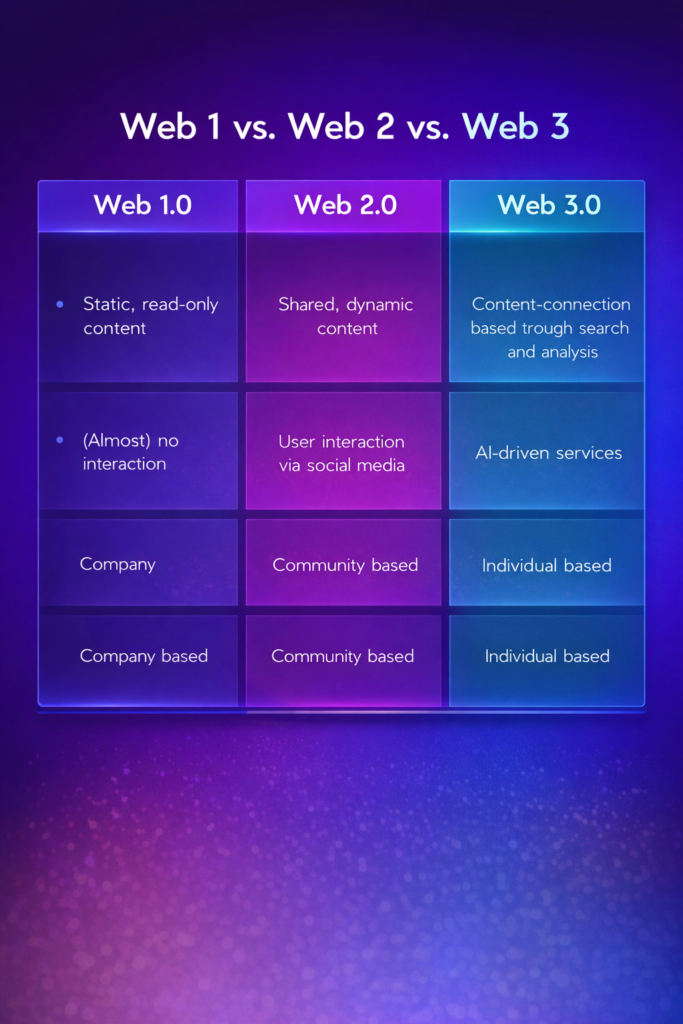
Before Web 3: A quick look at how the internet evolved
To really understand what is Web3, it helps to see how we got here.
Web1: Read-only internet (1990s)
Web1 was the earliest version of the internet:
- Static websites
- No logins, no comments
- You could read information, but not interact much
Think of it like reading an online newspaper.
Web2: Read & write internet (2005–today)
Web2 is the internet we use today:
- Social media, apps, cloud services
- You create content, comment, like, share
- But companies own the platforms and your data
Facebook, YouTube, Instagram, and Google are classic Web2 examples. You use them for free—but you are the product.
Web 3: Read, write & own internet (emerging)
This is where Web 3 comes in.
Web3 aims to:
- Remove centralized control
- Give users ownership
- Run on decentralized technologies like blockchain
What is Web 3 in simple words?
Here’s the simplest explanation:
Web3 is an internet where you control your digital assets and identity instead of big companies controlling them.
In Web3:
- You don’t “log in” with email and password
- You connect using a crypto wallet
- Your assets (money, NFTs, identity) live on the blockchain
- No single company can ban you or take your data
Instead of trusting companies, you trust code and networks.
The core technologies behind Web3 (explained simply)
Let’s break down the tech without jargon.
1. Blockchain: The backbone of Web 3
A blockchain is:
- A public, digital ledger
- Stored across thousands of computers
- Nearly impossible to alter or cheat
Popular blockchains like Ethereum power most Web3 apps today.
If you want a deeper technical view, Ethereum’s official documentation explains how smart contracts work in detail.
2. Smart contracts: Rules written in code
Smart contracts are programs that:
- Automatically execute when conditions are met
- Remove the need for intermediaries
For example:
- No bank needed for payments
- No broker needed for trades
- No platform needed to enforce rules
Once deployed, no one can secretly change them.
3. Crypto wallets: Your Web 3 login
In Web3, your wallet is:
- Your identity
- Your bank account
- Your login
Wallets like MetaMask let you:
- Sign in to apps
- Send money
- Own digital assets
No email. No password. No “forgot password” button.
Web2 vs Web3: The real difference that matters
📊 Quick comparison table
| Feature | Web2 | Web3 |
|---|---|---|
| Data ownership | Companies | Users |
| Identity | Email & password | Crypto wallet |
| Payments | Banks & gateways | Peer-to-peer |
| Control | Centralized | Decentralized |
| Censorship | Possible | Very difficult |
The biggest shift isn’t technology—it’s power.
Why Web 3 exists: The problem it’s trying to solve
Web3 didn’t appear randomly. It exists because Web2 has real problems:
- Platforms monetize your data
- Accounts can be banned overnight
- Payments depend on middlemen
- Creators lose control over their audience
I’ve personally seen creators lose years of work because an algorithm changed or an account got suspended. Web3 tries to fix this by removing single points of control.
What can you actually do with Web3 today?
Web3 is still early, but it’s already being used.
1. Decentralized finance (DeFi)
DeFi apps allow:
- Lending & borrowing without banks
- Trading without brokers
- Earning interest without institutions
Popular DeFi protocols are already handling billions in transactions daily.
2. NFTs (beyond just art)
NFTs aren’t just profile pictures. They can represent:
- Digital identity
- Event tickets
- Game items
- Royalties for creators
The key idea is verifiable ownership.
3. Decentralized apps (dApps)
Unlike normal apps:
- No central server
- No company controlling data
- Runs on blockchain networks
Examples include decentralized social networks, games, and marketplaces.
Is Web 3 really decentralized? (An honest take)
Here’s a fresh perspective many articles skip.
Web3 aims to be decentralized—but today, it’s not perfect.
Challenges include:
- Centralized exchanges
- Limited user-friendly tools
- High transaction fees during peak usage
- Complex onboarding for beginners
So if someone tells you Web3 is already flawless, that’s not true. It’s a direction, not a destination.
Web 3 myths you should stop believing
❌ “Web 3 is only about crypto price speculation”
Reality: Prices are just one small part. The real innovation is ownership and trustless systems.
❌ “Web 3 will replace Web2 overnight”
Reality: Web3 will coexist and integrate, not instantly replace.
❌ “You need to be a developer to use Web3”
Reality: Tools are improving rapidly, and user-friendly apps are emerging fast.
How Web 3 could change the internet long-term
If Web3 succeeds, we may see:
- Social media where creators own audiences
- Payments without banks or borders
- Digital identity you fully control
- Platforms governed by communities, not CEOs
This doesn’t mean companies disappear—it means users gain leverage.
Should you care about Web3 right now?
It depends.
- Casual users: Learn the basics, don’t rush
- Creators: Huge potential for ownership & monetization
- Businesses: Early exploration could be a strategic advantage
- Investors: High risk, high learning curve
My personal advice? Understand Web3 before you invest in it.
The future of Web 3: Realistic expectations
Web3 is still:
- Early-stage
- Experimental
- Rapidly evolving
But so was the internet in the 1990s.
Not every Web3 project will survive—but the idea of user-owned internet isn’t going away.
Conclusion: What is Web3, really?
So, what is Web3 in simple words?
Web3 is an attempt to rebuild the internet so:
- Users own their data
- Trust is built into technology
- Power is more evenly distributed
It’s not perfect. It’s not finished. But it represents a meaningful shift in how we think about the web.
Call to Action 🚀
What’s your take on Web3—revolution or hype?
👉 Share your thoughts in the comments
👉 Explore our related guides on blockchain and digital ownership
👉 Subscribe to stay updated as Web 3 continues to evolve. Subscribe Now.
Understanding Web 3 today could shape how you use the internet tomorrow.


Pingback: Why is the internet slow today? Common Reasons & Easy Fixes